

What 2025 Taught Us About Business and Technology
- Bucharest Tech Week
- Dec 16, 2025
- 6 min read

If 2024 felt like the year of experimenting with AI and “what if?”, 2025 felt like the year reality answered back: teams started implementing, leaders started asking tougher questions, and the best ideas weren’t the loudest, they were the most usable.
Over five days, we learned a lot from our speakers and just as importantly, from the people who joined us in the rooms, asked the hard questions, stayed after sessions to compare notes, and turned keynotes into conversations. This wrap-up is our way of capturing what we learned while it’s still fresh and using it as a stepping stone to prepare the ground for 2026.
Innovation Summit: Moving Beyond the Efficiency Trap
Our speakers explored what innovation looks like when “doing more, faster” isn’t enough anymore: running corporate strategy in decentralized organizations, balancing risk-taking with strategic foresight, the psychology of desire and purchase tension, and how brands can stay relevant in a world where AI changes the rules of attention, content, and decision-making.

Dominik Heinrich, Adjunct Professor AI Design at Pratt Institute and Co-Founder, Creative AI Academy, delivered the reality check we needed: "If you think AI makes you faster, you should quit your job. If you think AI makes you better, you're onto something really interesting that can help you gain competitive advantage."
The problem? We're caught in what Dominik calls "the efficiency wave", the first of three waves of technological adoption. Wave one is all about speed and cost-cutting. But speed without quality creates mediocrity by default.
From a strategic perspective, Anton Kotov (ABB) showed how this challenge plays out at enterprise level. Running corporate strategy in a fully decentralized organization means balancing global direction with local autonomy, not enforcing speed from the center, but enabling smart, context-aware decision-making across operating units.
Looking at the broader European landscape, Federico Menna (EIT Digital) pushed the conversation further. In times of crisis, playing it safe can feel comfortable, but it rarely leads to progress.
Together, these perspectives led to one of the most thought-provoking questions of the day: what happens when AI is no longer just a tool, but an actor? As Dominik pointed out, by 2026–2027, AI agents won’t just assist us, they will increasingly make purchasing decisions on our behalf. “AI is becoming a new consumer, very rational, very data-driven. How do you get through this as a brand?”
Future Summit: AI: From Experimentation to Agentic Systems
Our speakers focused on what comes after chatbots: the rise of AI agents, governance vs. innovation, trustworthy AI by design, AI for science and physical systems, and the growing need for cross-disciplinary teams that blend tech, design, psychology, and leadership.
The Future Summit: AI confronted 2025's defining question: How do we move from chatbots to truly autonomous agents? The numbers tell a compelling story. According to PwC's May 2025 survey, 79% of organizations report AI agents are already being adopted, and 88% plan to increase AI-related budgets in the next 12 months due to agentic AI.

Sterre van der Laken, Strategy and Programs Lead at Salesforce's AI Centre, grounded the conversation in reality: "Curiosity and openness to learning. AI is evolving at such an incredible pace that it's almost impossible to feel like or be a true expert. And that's okay." She shared a practice that's become her competitive edge: "trying to 'cheat' as much as possible with AI. I ask myself: How can I use AI to help me solve problems faster, be more productive, or just get clever about things?"
From there, the discussion naturally expanded to responsibility and scale. Luana Lo Piccolo (European Commission) addressed the growing anxiety around governance, challenging the idea that regulation and innovation sit on opposite sides.
At the same time, Andy Grant (NVIDIA) showed how AI is already reshaping scientific workflows, from protein folding to weather forecasting, using physics-informed neural networks and agentic systems. Susi Merighi (Deloitte) underlined that trustworthy AI by design is not just about compliance or risk mitigation. Done right, it becomes a true market differentiator.
The biggest misconception companies have when starting with AI agents? "...thinking that success is all about the technology. It's not. The real shift is in mindset." Sterre explained.
HR Masters Summit: The Superhuman Workforce in an Age of Uncertainty
The HR Masters Summit began with a simple question posed to HR professionals: If you had a superpower, which would it be? The answers, reading minds, flying, time travel, invisibility, revealed the genuine struggle of managing human complexity at scale.
Nazim Unlu, Global HR & Transformation Lead at Novartis, used this to frame 2025's HR reality: we're living in what he calls "fundamental uncertainty", borrowed from quantum physics. "You know the whole realities about your organization as a leader. But you don't have a chance to make it precision."

This idea echoed throughout the summit. Claire Renaud from Dell spoke about agile HR and modern leadership as a daily practice, not a title. Leadership today is a conscious choice, one that blends people, data, and technology to create resilient organizations. Donatella de Vita from Pirelli showed how structured global welfare programs, like MORE, can become anchors of stability and engagement, while Aleksandra Szymanowicz-Siwiec from bp highlighted engagement as a powerful defense mechanism when uncertainty becomes the norm.
Software Architecture Summit: Building for a Multi-Cloud, Event-Driven Future
Our speakers explored Azure messaging and standards, multi-cloud strategies, event-driven architectures, microservices fragmentation and developer portals, and practical analytics across distributed data, basically, the decisions that determine whether a company can scale reliably (or quietly pays “complexity tax” forever).
The Software Architecture Summit confronted a reality most organizations are already living: 86% of companies now operate in multi-cloud environments, according to InfoQ's 2025 research. The question isn't whether to go multi-cloud, it's how to do it without creating chaos.
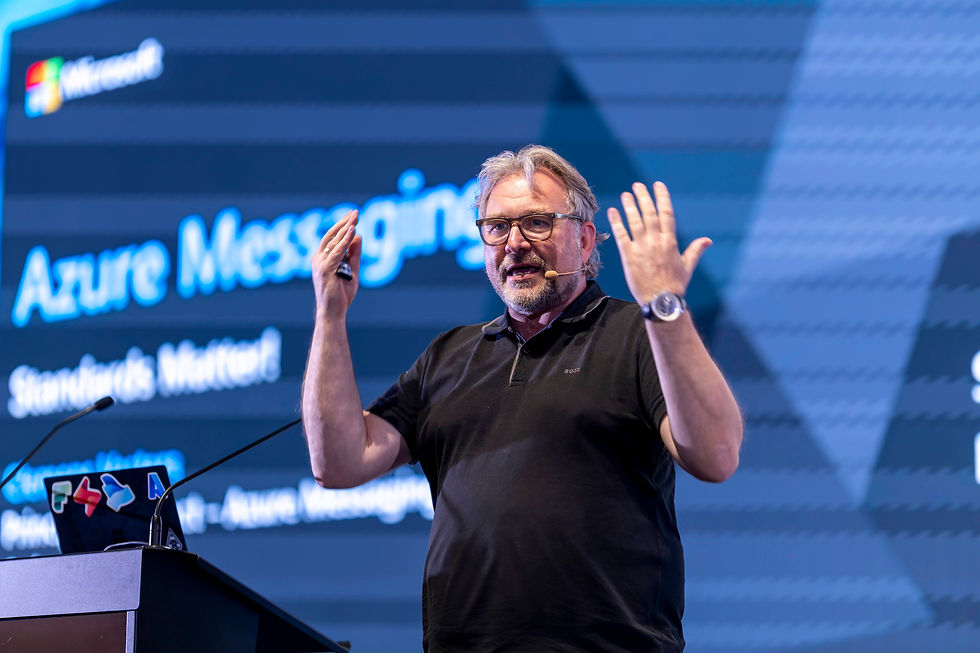
Clemens Vasters, Principal Architect for Azure Messaging at Microsoft, made the case for why this matters: "Standardization is essential for multi-cloud environments because you want to have your workloads be able to move across clouds and to be agile across clouds."
Ioannis Canellos from Red Hat introduced Backstage, a solution to the chaos created by microservices fragmentation, while Marco Pierobon from Thoughtworks tackled multi-cloud head-on, helping teams understand when they should start thinking about multi-cloud and which operating model fits their organizational needs.
For those entering the tech industry, Clemens offered direct advice: "Find a niche, find one thing that you're really, really good at and double down on it."
AI Coding Summit: Rethinking Development, Not Just Accelerating It
Our speakers explored multi-agent orchestration, observability for AI/LLM apps, vector embeddings and RAG for more reliable chatbots, multi-cloud for developers, and a bigger point: AI doesn’t just accelerate development, it forces teams to rethink what they build and how.

Sonika Kapil, AI & App Chief Architect at Microsoft, framed it perfectly: "The future of AI is agentic, and I know it's a buzzword, but it's also thinking, you know, rethinking their processes in terms of AI. And I think that's what companies should prepare for."
Her message was clear: "If you want to derive true value, then you have to look at your processes. Where is it possible to optimize and rethink your processes with the help of AI?" While chatbots are "very nice," true value comes from holistic process transformation.
Corrado De Bari from Oracle explored vector embeddings and their role in RAG (Retrieval-Augmented Generation) for building smarter chatbots that can efficiently search and retrieve unstructured data. The technical debt challenge facing enterprises will be addressed through multi-agent systems, Sonika explained. Just as human teams require multiple specialists working together, solving complex tasks requires multiple specialized agents collaborating with "human in the loop approach. We are not ready for full automation, at least not yet."
Conclusion: The Human Imperative in a Tech-Driven World
Across five summits and dozens of sessions, one theme unified every conversation: technology is advancing faster than ever, but competitive advantage belongs to those who keep humanity at the center.
Whether it's Dominik's reminder that better AI requires better humans, Sterre's emphasis on curiosity and cross-disciplinary thinking, Nazim's call to support people through uncertainty, Clemens's commitment to open standards that serve everyone, or Sonika's vision for rethinking rather than just accelerating: the message is consistent.
The transformation is real, immediate, and unavoidable.
But here's what separates winners from the rest: broad adoption doesn't always mean deep impact. Many employees use agentic features in enterprise apps to speed up routine tasks, but few organizations have made the bold, strategic shifts needed to sustain long-term success.
As we move toward 2026, the question isn't whether AI will transform work, it will. The real question is:
How will your organization design the relationship between people and AI to amplify human creativity, empathy, and strategic thinking rather than diminish it?
The future isn't about choosing between human and machine. It's about designing systems where both thrive. Join us next year as we continue exploring this intersection at Business Summits 2026.


Really enjoyed this. The post managed to be informative without feeling heavy, and the examples helped https://boxes4products.com/ make the ideas easier to relate to. I recently came across a similar perspective on a boxes4products-based review blog (boxes4products), and it offered another thoughtful angle.
This article offers such a sharp, forward-looking perspective on the essential lessons from 2025 for business and technology, really cutting through the noise. It emphasizes getting to the core of what works, much like the clean, undeniable precision of a BALDFADE.
Remarkably well-explained, this post delivers useful insights in a simple and approachable way. The flow of information makes it easy to stay engaged and understand the core message. I recently came across a similar discussion on a review blog, and it offered an interesting perspective as well. In that context, I’ve also seen https://www.globalmoldsolutions.com/ mentioned, which adds another layer to the topic. This was a genuinely helpful and enjoyable read.
Un prieten mi-a trimis link-ul către worldcasinoexpert.ro/casino/22bet/ după o perioadă destul de stresantă, mai mult ca o glumă ca să mă mai deconectez. Am intrat într-o noapte când nu aveam somn și m-a surprins atmosfera relaxată, fără zgomote inutile. Mi-am făcut un ceai, m-am așezat confortabil pe canapea și am reușit să mă liniștesc după săptămâni întregi de muncă intensă. Chiar am început o conversație plăcută cu cineva acolo. A fost exact pauza de care aveam nevoie în acel moment.
This article presents technology in an empowering and accessible way. The idea of innovation as a “superpower” is both motivating and relatable. It’s exciting to think about how tools can unlock potential. I recently came across a thoughtful perspective on a https://bonhamcounseling.com/ about growth through innovation that aligned nicely.